Make the Brief Yours
Choose the mystery direction, difficulty, setting, tone, audience and game language. Check the live Case Preview before you copy Prompt 1.
Basic Case Starter · Guided AI Game Creation Kit
Choose a mystery direction and the available game options, then copy five prepared prompts into ChatGPT one at a time. They guide case planning, evidence logic, game-code generation, and repairs based on your playtest notes.
Case Starter: The 5-Step AI Detective Mystery Game Prompt Kit gives you a downloadable prompt tool that opens in your browser. Configure your case, follow the five checkpoints, and copy the prepared prompts into ChatGPT. Your purchase includes the prompt tool—not a finished game or AI subscription.

You can picture the room, the suspects, and the clue that changes everything. A player picks up a record, compares it with another piece of evidence, and spots a detail that does not fit. You have the mystery. Turning it into a 3D scene that responds to a player is the part you have never done.
If you have never coded a game, even the first step can feel out of reach:
You want to test the mystery itself: can a player discover the clues and reach a fair conclusion? You do not want to spend that first session inventing prompts or trying to write the entire game from scratch.
The idea stays in your notes. Or you ask AI to “make a detective game,” get a promising-looking answer, and have no clear way to check it. One fix leads to another: the scene works, but a clue is missing; the ending works, but the evidence does not explain it. Without a plan, it is hard to know what to ask next.
Commissioning a custom game can involve significant planning, time and expense. That can be appropriate for a developed project, but you may want to explore a small prototype before making that commitment.
A more manageable starting point is to separate the creative brief, the mystery’s logic and the technical build—so you have one decision to review at a time.
Describe what players can inspect, what each clue reveals, and how the case should unfold. AI can turn those plain-language instructions into a case plan and draft game code, so you can begin without writing every line yourself.
Then try the build: click a clue, compare two records, and see whether the evidence supports the conclusion. Your observations give the AI something specific to revise. The missing piece is knowing what to ask—and in what order.
The five prompts are already written, organized, and refined. Case Starter gives you the request, expected response, and review checkpoint at each stage. Spend less effort inventing the AI conversation and more attention on the mystery.
Your supported choices and feedback shape the draft. The kit keeps the project compact: one case, three suspects, and three investigation phases.
Send the prompts in order, keeping one case in one AI conversation. Read the response and approve its checkpoint before continuing.
Your configuration gives those requests a direction.
Set your brief, check the live Case Preview, and copy Prompt 1 with your choices already inserted. The sidebar keeps your place; search helps you find guidance. Your separate AI chat produces the case and code.
Picture a player inspecting a 3D object, recording a clue, and comparing it with evidence already found. The prompts request direct object interactions and character reactions, with a hint system and evidence board selected by default. Want players to question suspects? Select the optional scripted interviews. Optional inventory and a brief branching choice also stay within the same three investigation phases.
Choose the mystery direction, difficulty, setting, tone, audience and game language. Check the live Case Preview before you copy Prompt 1.
Ask for progressive hints and a discovered-clue board. Add short suspect interviews or a small inventory when they suit your case.
The prompts require exactly three suspects and three action-based investigation phases. Optional features do not expand the case into a large project.
Copy, find, and follow: Use Copy prompt to copy the current prompt, or Select text to copy it manually. Search helps locate relevant prompt guidance, while stage navigation and the next assignment keep your place in the workflow.
Choose a small museum after closing. Request clues players can inspect and records they can compare, with optional suspect interviews if you want them. Use the checkpoints above to develop the evidence before asking for the 3D build.
Illustrative setup, not a customer result or promised game output.
An object has disappeared. Guide the AI toward a case built around evidence of removal, opportunity and responsibility.
Someone is unaccounted for. Guide the AI toward a fictional, non-graphic investigation with a safe resolution.
Something doesn’t add up. Guide the AI to establish what happened and support a conclusion with obtainable evidence.
These are three selectable mystery directions. The AI authors an original case for your chosen direction; they are not three finished games in the download. Choose the direction that fits your idea, then adjust the supported options.
After purchase, you receive a downloadable file containing the Case Starter prompt tool. Extract the download and open the tool in a modern browser. No code editor is required to use it. Have access to ChatGPT and a plain-text editor ready to save the generated game code.
Follow the generated game’s launch instructions: it may need internet access, a library, or a local server.
A practical starting point for AI-curious storytellers and beginners willing to review the case, follow launch instructions, and test the result. It suits a small prototype rather than a large production-ready project.
Designed for ChatGPT; other capable AI tools can give different results. Allow time to test your build and work through repairs. Your AI tool’s access and any charges are separate. See the disclaimer below for the limits of AI-generated output.
You can start by directing the AI rather than writing the game code yourself. You still save its code, follow launch instructions, and report specific problems. A plain-text editor can save the generated game code; a dedicated code editor is optional.
Yes, through the supported configuration options and feedback to your AI. Suspect interviews, inventory, and a brief branching choice are optional. Basic keeps the investigation to three suspects and three phases.
The prompts prefer a single browser-playable game file but allow documented dependencies. Check the launch instructions of the actual game your AI supplies.
The three Basic choices are mystery directions, not prebuilt games. If you want more varied settings after trying the workflow, Advanced is an optional next step; Basic does not require an upgrade.
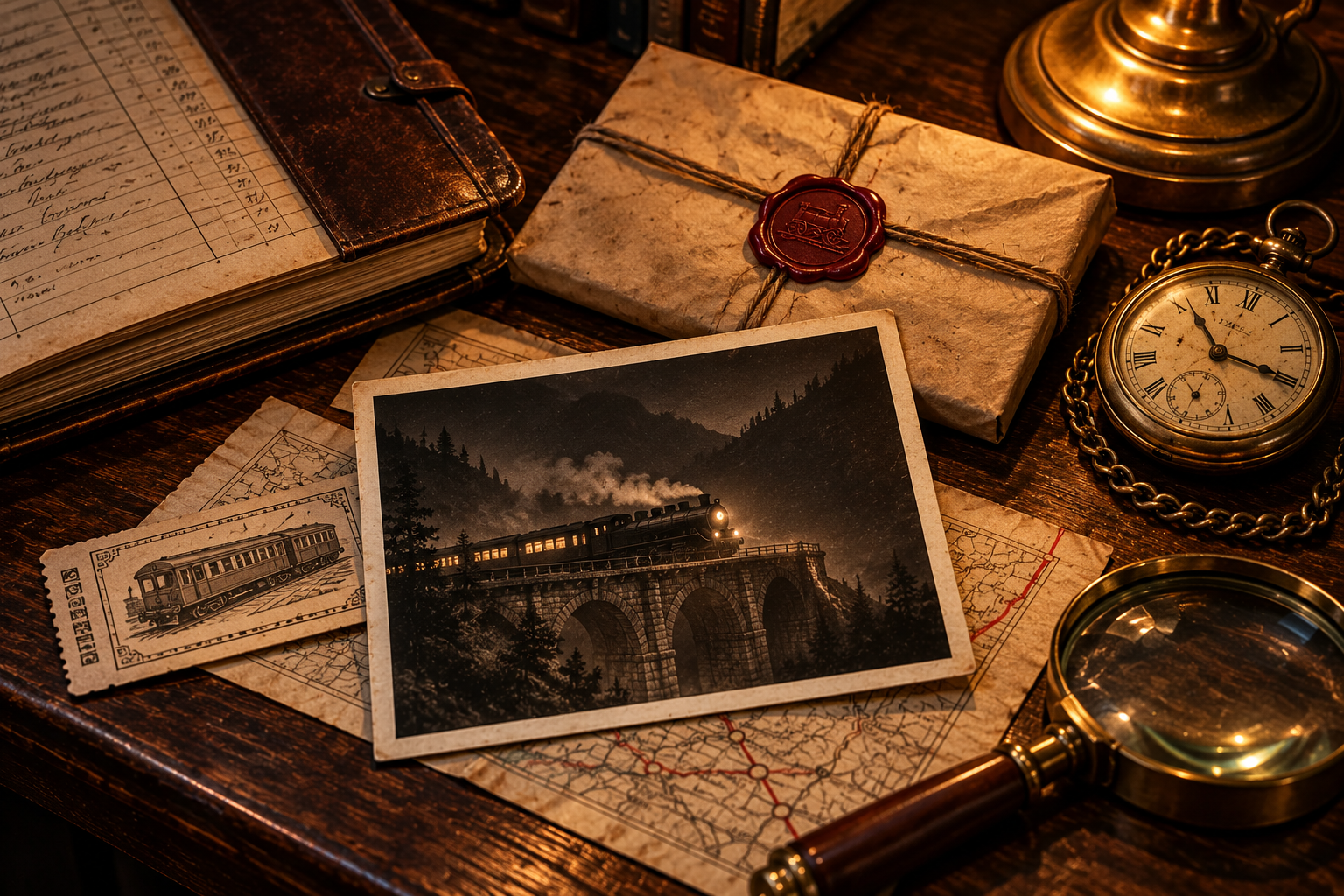


Setting illustrations from the Advanced prompt kit, not screenshots of finished games.
Six authored scenario briefs and prompt sequences, spanning museum theft, missing person, suspicious incident, a night train, an old theater, and a storm-bound hotel. Each has its own cast and evidence plan.
The prompts request more refined character graphics and clearer in-game guidance. Advanced is a broader prompt kit, not six finished games; the images above illustrate its settings.
No Advanced purchase, signup, or checkout is active here. The offer link will be added once its destination is confirmed.
Basic Case Starter
Planned regular price $17
Introductory price$9.90
First-launch introductory offer: $9.90.
Checkout is not active on this preview page.
Case Starter: The 5-Step AI Detective Mystery Game Prompt Kit — Basic package. Start with a prepared sequence and make the creative choices yours.
Your mystery deserves a first experiment. Start with a prepared path and put your attention on the clues, characters, and decisions that make it yours.
Purchasing is not active on this preview page. No payment is processed and no customer information is collected here.